
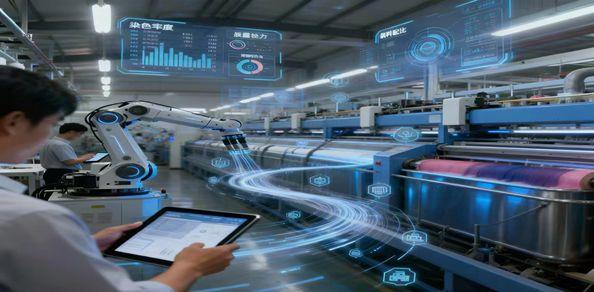



The automated liquid dispensing systems is designed for the weighing and feeding of auxiliaries in the production process of printing and dyeing enterprises. It is a new type of industrial automation solution, replacing manual feeding with automatic dispensing. It can solve the problems caused by human factors such as inaccurate weighing, weighing errors, and delayed feeding resulting from manual operation. After application, it can improve production efficiency, increase the first-pass yield of products, save labor, reduce waste, and cut costs.
This system can be applied to dyeing machines, setting machines, pre- and post-treatment equipment, etc.
The automated liquid dispensing systems can manage and configure multiple auxiliaries required by various machines simultaneously, and it is also suitable for liquid dyes and brighteners (specially designed).
The reliable design endows the equipment with extremely high stability.
The system automatically records data, enabling enterprises to conduct precise cost analysis and consumption analysis based on its reports, which is beneficial to the refined management of enterprises.
Advantages and Characteristics:
1.It has an automatic cleaning function for the auxiliary dispensing pipeline, and the cleaning effect is excellent.
2.For customers with high requirements for dosing accuracy , they can choose the large and small flow mode or the proportional valve mode as an option.
3. The dispensing pump adopts frequency conversion control. When it approaches the target dosing volume, it can slow down the dispensing speed to improve the dosing accuracy.
4. A single liquid dispensing can support the simultaneous dispensing of up to three branches at most.
5. It supports the separate metering of liquid caustic soda and shares the on-site dispensing pipeline with other auxiliaries.
6.A mass flowmeter can be optionally installed.
7. An auxiliary material dissolving machine can be optionally installed, which is used for dissolving powder auxiliaries or diluting viscous auxiliaries.
8. The system automatically records the data of each dispensing, enabling data traceability of the production process.
9. The system automatically manages the consumption of additives and generates reports.
System parameters:
Quantity of additives | N types (within 30 types; more than 30 types require special plans) |
Viscosity of liquid additives | Less than 1000cps |
Measurement accuracy | The Φ of the special train small tube is 14:100g -500g ±5g, and over 500g ±2%. For general pipes with Φ25.4: ±10g for 200g-1000g, ±2% for pipes over 1000g |
Delivery speed | Φ25.4 tubes :20-40L/Min, Φ14 tubes: 5-15L/Min |
Minimum weight for additive delivery | Dyeing machine: 100g, setting machine: 300g |
Specifications of the storage tank | 300L, 500L, 1000L, 1500L, LLDPE or 316 stainless steel material |
Loading materials | Diaphragm pump, 40L/Min, head 10M. |
Number of connected machines | N units, depending on the demand |
Specifications of the material melting/thinning machine | Made of 300L, 500L and 316L stainless steel, it has steam heating function and needs to be used in combination with the additive distributor |
Height (including the height of the storage tank and the platform | The height required for the distributor to be placed below the storage tank is 4.5M, and the height required for the distributor not to be placed below the storage tank is 3.2M |
Energy conditions | Water pressure: 0.3Mpa Power supply: Three-phase 380V, 50HZ to the main equipment, power 5-30KW; Compressed air: Pressure 0.6Mpa Steam: Temperature 180 degrees, pressure 0.3-0.4Mpa |