



The Dyeing Machine Central Monitoring and Management System is a comprehensive control system that emerges in response to the automation of modern large-scale industrial production and the continuously rising requirements of process control. It is the result of the combination of computer technology, system control technology, network communication technology, and multimedia technology. It is networked via Ethernet communication to form a distributed 集散 control system, which monitors and manages all dyeing machines. It has become the standard supporting control and management mode for the dyeing workshop.
In the textile industry, the data of the central control system, ERP, and automated dosing systems are seamlessly integrated, enabling automatic material dispensing calls and production information monitoring and statistics without human intervention. It can also better monitor the production status of the workshop, analyze historical production situations in a timely manner, improve production efficiency, enhance product quality , reduce production energy consumption, minimize human errors, and cut labor costs.
By conducting centralized or decentralized monitoring of the dyeing machine computer, it records the data throughout the entire dyeing process , reducing quality accidents caused by factors such as tank differences, color differences, and equipment failures due to human factors during the dyeing process. Meanwhile, it reduces the dependence on manual skills. The central control system has the control authority over the entire dyeing process, which can restrict and monitor the arbitrary operations of dyeing vat operators, ensuring the complete and correct execution of the dyeing process. The consistency of the production process is achieved through the precise control of the central control system.
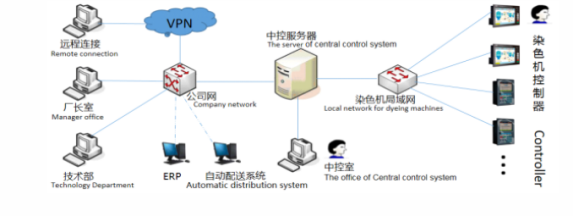
The central control system is a multi-user network version that keeps the original dyeing machine computer under on-site control. It uses Ethernet or RS-485 communication to achieve computer network management. Accounts with different permissions can be created in different departments. According to the needs of each department, tasks such as formulating production plans, editing and transmitting process programs, monitoring and operating dyeing machines, querying historical production data, conducting statistical analysis of reports, and viewing production process curves such as temperature, water level, and material feeding can be carried out. Additionally, it can be accessed via the Internet to enable remote mobile work.
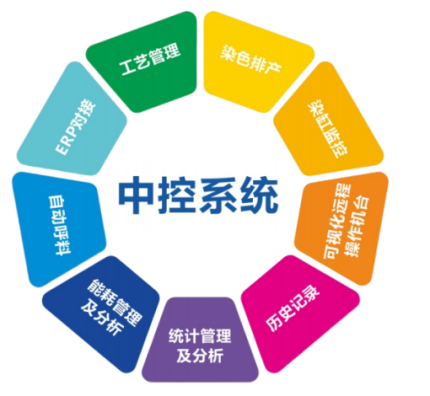
To meet the diverse needs of customers at different levels, different versions of the Tianfu Dyeing Machine Central Monitoring and Management System software can be provided:
Basic Version: Process Management/Dyeing Scheduling/Dyeing Vat Monitoring/Remote Control of Machine Units/Historical Records/Statistical Reports
Advanced Version: Process Management/Dyeing Scheduling/Dyeing Vat Monitoring/Remote Control of Machine Units/Historical Records/Statistical Reports/Energy Consumption Management/Integration with Tianfu ERP/Multi-language Management
Professional Edition: Process Management/Dyeing Scheduling/Dyeing Vat Monitoring/Visualized Remote Operation of Machine Units/Historical Records/Statistical Management and Analysis/Energy Consumption Management and Analysis/Integration with Tianfu ERP/Automatic Material Request by Tianfu System/Multi-language Management
Personalized Function Customization (Options) :
1. Large Screen for Production Scheduling
2. Large Screen for Production
3. Automatic Dyeing Scheduling System (APS)
4. Connection to the Dye Solution Testing System
5. Interface with Third-party ERP Systems
6. Connection with the Third-party Automated liquid dispensing systems
7. Connection with the Third-party Automated liquid dispensing systems(salt and alkali)
8. Connection with the Third-party Automated powder dosing systems
9. Mobile Applications: They can be accessed via browsers, apps, WeChat Mini Programs, etc.Users can start using them after creating an account.
Process management: It features process management functions such as creating, modifying, copying, and reviewing dyeing processes, and assigns multiple management permissions to process operations, refining the requirements for process control.
Dyeing production scheduling: In the dyeing production process, the dyeing production scheduling plan is a crucial part.In the central monitoring and management system of the dyeing machine, production tasks can be arranged in advance, with the corresponding production batches scheduled behind the corresponding machine units.Once the current production task is completed, the production tasks and information of the next batch will be automatically uploaded to the dyeing cylinder controller, making the production more compact and coherent.
Dyeing Vat monitoring: It monitors and records the real-time production status, operation steps, time, alarms, water level, temperature, flow rate, pressure, pump speed, manual operation, etc. of the dyeing machine, and offers multiple monitoring mode displays including single machine, global, curve, and progress. All operations on the dyeing machine controller can be controlled and completed by a single computer in the central control, effectively improving the concentration of operations. The dyeing vat controller can be synchronously controlled and operated through the central control system, such as changing functional parameters and adding steps.
Remote control access to the machine unit: On a computer or mobile phone, directly connect to the dyeing machine controller (control computer) remotely to view the production status in real time, operate and adjust the process, and achieve direct control of the dyeing vat at any time and place.
Historical records: For completed production batches, the status and process are all recorded in the central control computer. As required, the completed batches can be analyzed. Historical records are of great assistance in quality control and can also enable a timely and clear understanding of whether the equipment is operating normally. In case of any abnormal situation, the maintenance department can clearly, accurately and promptly locate the fault point of the equipment and conduct inspections and repairs.
Statistical reports: After collecting data from the dyeing machine, the system provides reports such as dyeing progress query, process energy consumption, timeout rate, and shutdown rate. After integrating some data with the ERP system, production output reports can be generated. Data from water, electricity, and steam meters can be collected through the dyeing machine controller to monitor and manage the energy consumption of the dyeing machine and generate energy consumption reports. Machine fault reports can be generated based on alarm/fault records, etc. These reports provide strong data support, through which the real production and management processes in the production workshop can be observed.
Energy consumption management: It has an independent energy consumption collection and analysis reporting function, enabling centralized monitoring and management of the water, electricity, and steam consumed by dyeing machines.
Automatic material calling: By seamlessly integrating with the ERP system and the automated dosing systems for data, automatic material calling can be achieved, enabling the automatic transmission of material dropping information throughout the entire process without human intervention. The central monitoring and management system for dyeing machines is also a key element for the dyeing workshop to achieve automated and intelligent production.
Network map of central control system