

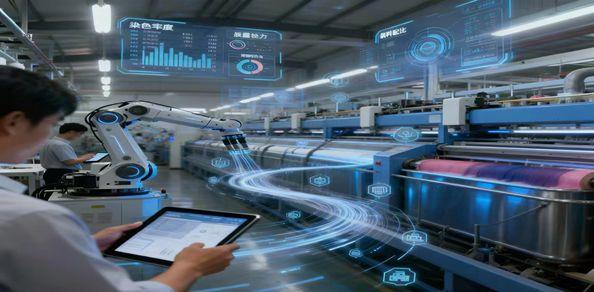



The central monitoring and management system for setting machines is a comprehensive control and management system that emerged in response to the automation of modern large-scale industrial production and the constantly rising requirements of process control. It is the result of the combination of computer technology, system control technology, network communication technology, and multimedia technology. It is networked via Ethernet communication to form a distributed control system , which monitors and manages all setting machines and can interface with the ERP system. It will become the standard supporting control and management mode for printing and dyeing factories.
The central monitoring and management system for setting machines is a multi-user network version. It maintains the original on-site control of the setting machine computer and uses Ethernet communication to monitor and record the fabric width, oven temperature, fan frequency, main machine speed, upper overfeed, lower overfeed, tension, and other working conditions of the setting machines in the dyeing and finishing workshop, achieving computerized network management. After the machine scheduler uploads the process, the central monitoring and management system of the setting machines automatically adjusts the parameters of the corresponding setting machines in sequence according to the received process parameters, enabling the automatic setting of the process parameters for the setting machines.Accounts with different permissions can be created in different departments. According to the specific needs of each department, tasks such as formulating production plans, conducting monitoring and operations, querying historical production data, and creating statistical analysis reports can be carried out. It can also be accessed via the Internet to enable remote mobile work.
Modules and functions of the central monitoring and management system for setting machines:
1.Machine Unit Information Management: Manage and configure the basic information of machine units;
2.Process Sheet Management: Creating, editing, and searching for process sheets;
3.Production Scheduling Management: Conduct production scheduling, assign setting tasks , and issue them to each machine unit one by one in the order of production scheduling.
4. Historical Curve Query: Query the historical actual operating parameters of each machine unit.
5. Setting Production Record Query: Query the setting production records of each machine unit.
6. Alarm Record Query: Query the alarm records of each machine unit.
Advantages and Characteristics:
1.It can support the monitoring of setting machines from multiple brands.
2. It is able to transform manual and semi-automatic setting machines into automatic setting machines.
3.It supports connection with both the PLC of the setting machine and the upper computer software of the setting machine.
4.One can choose either just to monitor or to conduct comprehensive monitoring.
5. It supports data docking with the factory's ERP system;
6.The production process data is recorded in real time and can be used for data traceability.