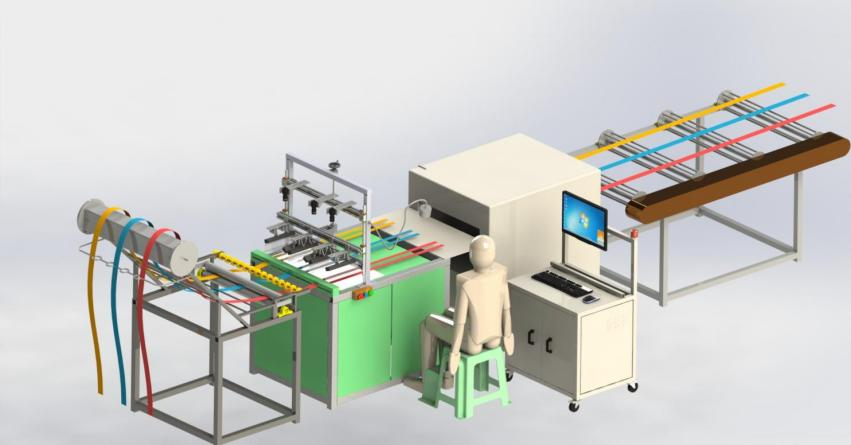





ONE. Product Background:
Webbing enterprises still face the issue of low operational efficiency in the quality inspection of finished products:
1. When it comes to detecting webbing defects relying on human eyes, it is time-consuming, and human eyes are prone to fatigue. There is a high probability of missed detection, it is inefficient, and the quality is hard to ensure. Moreover, the cost of recruiting employees is quite high.
2. Manually filling in labels, with dedicated statisticians entering data and tracking reports, makes it difficult to promptly know the execution progress and loss situation of orders.
3. The historical data of the inspection is stored in paper documents, making it difficult to query this historical data and to conduct quality traceability.
4. Additionally, due to the lack of data statistical capabilities, it is impossible to achieve the objectives of effective quality management.
TWO. Product Introduction:
This product is an intelligent real-time online webbing defect detection device based on artificial intelligence and image recognition technology. It can detect, classify, and determine the location information of defects in finished webbing. It is an intelligent robot that integrates defect marking, storage, and quality report generation.The equipment of this system can be upgraded to be networked and monitored with the enterprise ERP system or the cloud, or it can operate as an independent system. This can improve the efficiency of quality inspection for customers, reduce the equipment's dependence on human labor, minimize the impact of human factors during the inspection process, enhance the efficiency of webbing defect detection, achieve non-contact and non-destructive testing, increase the degree of automation in enterprise quality inspection, and boost the informatization level of enterprises.
THREE. Product Features:
1.High-efficiency detection algorithm: It can detect and record webbing defects in real time. The designed movement speed of the webbing is 60m/min, and the minimum detectable defect size is a defect of 0.2mmx0.2mm.
2. High detection accuracy: It can quickly and accurately identify the location information and classify various defect types with different sizes, directions, and shapes, including white spots, black spots, frayed areas , indentations, skipped yarns, pulled yarns , missing wefts, broken wefts, exposed rubber strips , filament shedding, wrinkles, stop marks, protruding edges, frayed edges and many other defect types.
3. Adaptive capability: It can automatically enrich the data set. For the defect detection of new webbing, the algorithm is transferable to ensure the continuity of the detection environment.
4. By making minor modifications to the customer's existing equipment, the installation of the real-time hardware system can be completed.
5. The system automatically detects shutdown alarm warnings, records defect information, and generates quality reports. The data is automatically uploaded to the ERP or cloud system.